

Lithium Battery vs Lead Acid Golf Cart: 2026 Guide
Table of Contents
- Lithium Battery vs Lead Acid Golf Cart: The Quick Comparison
- Weight, Speed, and Hill Performance: What Changes on the Road
- Golf Cart Range With Lithium Batteries: How Far Can You Go?
- Golf Cart Lithium Conversion Kit: Drop-In vs Full System Swap
- Lithium Battery Charging Best Practices: Speed, Safety, and Storage
- BMS and Cold Weather: What Lead-Acid Users Never Deal With
- Cost, Lifespan, and Resale Value: The Long-Term Math
- Conclusion: Choosing the Right Battery for Your Golf Cart
- Frequently Asked Questions
Last Updated: September 23, 2026
Lithium Battery vs Lead Acid Golf Cart: The Quick Comparison
The lithium battery vs lead acid golf cart decision comes down to three things: weight, lifespan, and total cost of ownership. Lithium packs typically weigh 60-70% less than equivalent lead-acid setups, deliver more usable amp hours, and last several times longer. This guide from Golf Cart Geeks breaks down what actually changes on the road, in the garage, and on your wallet.
Lithium battery vs lead acid golf cart is a comparison of two chemistries: lithium-ion (usually LiFePO4) versus flooded lead-acid.
| Factor | Lead-Acid | Lithium (LiFePO4) |
|---|---|---|
| Weight (48V pack) | Very heavy | 60-70% lighter |
| Usable capacity | ~50% of rated | ~80-90% of rated |
| Maintenance | Watering, cleaning | None |
| Cycle life | Short | Long |
| Upfront cost | Lower | Higher |
Weight, Speed, and Hill Performance: What Changes on the Road
Weight reduction is the single biggest performance change you'll notice. A typical lead-acid 48V pack weighs several hundred pounds. A lithium pack of the same voltage weighs a fraction of that.
- Acceleration: noticeably quicker off the line
- Hill climbing: less bogging, more consistent torque
- Handling: better braking and cornering with less mass up high
- Range: more miles per kilowatt hour
Golf Cart Range With Lithium Batteries: How Far Can You Go?
Golf cart range with lithium batteries depends on pack size, terrain, and load. A well-matched lithium pack can roughly double the usable range of a comparable lead-acid setup because you can safely discharge deeper without damaging cells.
Factors that shrink your range:
- Hills and stop-start driving
- Cold temperatures
- Heavy loads or passengers
- Aggressive acceleration
- Underinflated tires
Golf Cart Lithium Conversion Kit: Drop-In vs Full System Swap
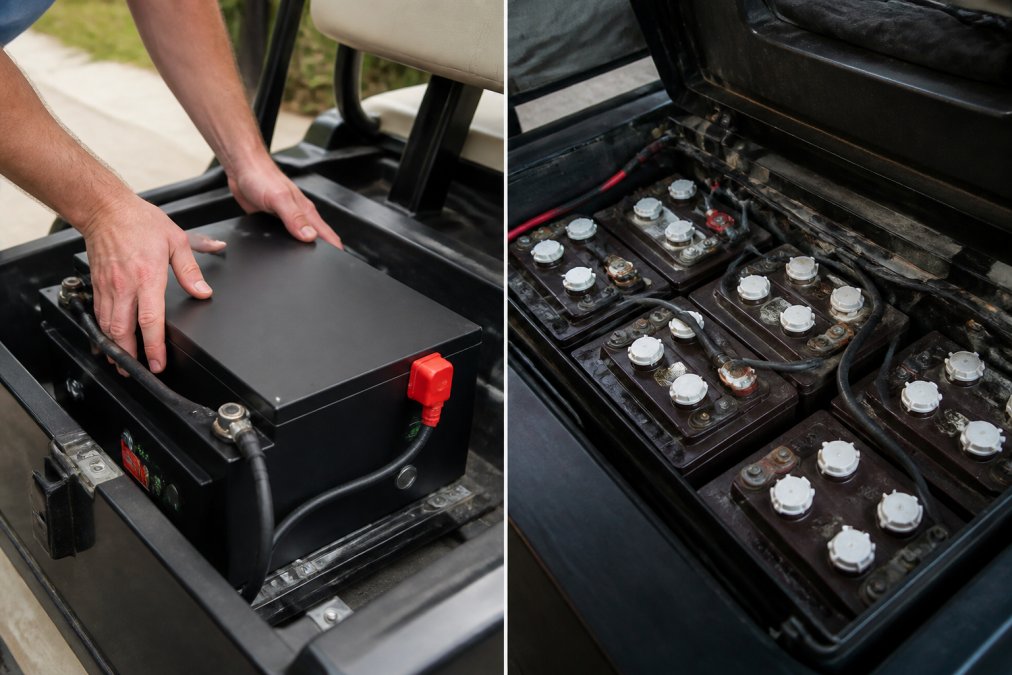
A golf cart lithium conversion kit comes in two main flavors: drop-in replacements that fit your existing battery compartment, and full system swaps that include a new charger, mounting hardware, and sometimes a controller upgrade.
Lithium Battery Charging Best Practices: Speed, Safety, and Storage
Charging is where lithium and lead-acid diverge the most, and it's also where most DIY conversions go wrong. The chemistry doesn't just accept a different voltage curve, it requires a different charging algorithm, and using the wrong one is the fastest way to kill a pack.
Why your old lead-acid charger won't work
A lead-acid charger runs a three-stage profile: bulk (constant current), absorption (constant voltage), and float (lower constant voltage to hold the pack at 100%). That float stage is the problem. Lead-acid wants to sit at full charge, so the charger keeps trickling current in indefinitely. A lithium (LiFePO4) pack does not want to sit at 100%, holding it there accelerates cell degradation.
When you need a new charger vs. when you don't
This is the single most common point of confusion for DIYers, so here's the decision rule:
- You need a new charger if: you're switching from flooded lead-acid to LiFePO4, your current charger has no lithium profile, or your charger is a dumb transformer-based unit with no voltage sensing.
- You may be able to keep your charger if: it's a modern smart charger with a selectable lithium mode (many Delta-Q, Lester, and Schauer models have this), or the lithium kit you bought ships with an integrated charger port and onboard charger.
- You almost always need a new charger if: you're changing system voltage (e.g., 36V lead-acid to 48V lithium), because the charger's output voltage is fixed by its transformer or firmware.
Charge speed and efficiency
LiFePO4 accepts charge current much faster than flooded lead-acid without the gassing and heat that damage lead plates. In practice, a lithium pack can often go from 20% to 100% in a few hours, while a comparable lead-acid pack may take 8-10 hours or more. Lithium also has higher round-trip efficiency, less energy is lost as heat, so the same wall outlet delivers more usable miles.
Storage: the 50% rule
Lithium packs age fastest at the extremes: sitting at 100% or sitting at 0%. For long-term storage, say, a seasonal property or a cart you won't use for months, charge to roughly 50% state of charge and disconnect the pack. Check it every few months and top it back to about 50% if it has drifted. Lead-acid storage is the opposite: it wants a full charge and a trickle maintainer, and it self-discharges faster.
LiFePO4 charging voltage reference
BMS and Cold Weather: What Lead-Acid Users Never Deal With
Most comparison articles treat the BMS as a footnote and cold weather as a one-line caveat. Those are actually the two things that most often surprise new lithium owners, and the two areas where lithium and lead-acid behave most differently.
What a BMS actually does (in plain English)
The Battery Management System is a small circuit board inside the lithium pack that sits between the cells and everything else. Lead-acid has no equivalent, the battery is just plates and acid, and the charger and cart controller do all the regulating. Lithium cells are far less forgiving, so the BMS takes over four jobs:
- Cell balancing: Individual cells in a pack drift apart in voltage over time. The BMS bleeds small amounts of current from the higher cells so the whole pack stays in balance. Without this, the weakest cell limits the whole pack.
- Overvoltage and undervoltage protection: If any cell goes too high or too low, the BMS cuts the current. This is why a lithium cart can suddenly shut off near empty, the BMS is protecting the cells, not failing.
- Overcurrent and short-circuit protection: If the controller or wiring draws too much current, the BMS disconnects. This protects both the pack and the cart.
- Temperature protection: The BMS reads cell temperature and blocks charging or discharging outside safe limits. This is the feature that matters most in cold climates.
How cold weather actually affects each chemistry
Cold affects both chemistries, but in different ways and with different consequences.
What this means for northern-climate owners
If you store or operate your cart in a cold climate, three practical points matter:
- Discharge is fine, charge is not. You can usually drive a cold lithium pack; you just can't charge it until it warms up. Some owners run the cart for a few minutes to warm the pack before plugging in.
- Heated BMS options exist. Some lithium packs ship with internal heaters that warm the cells to charging temperature automatically. If you're in a northern climate, this is worth asking about.
- Lead-acid isn't better in cold, it's just differently bad. Lead-acid loses capacity and sulfates; lithium loses capacity and blocks charging. Neither chemistry loves winter, but lithium's protection is active and reversible, while lead-acid's damage is cumulative.
LiFePO4 low-temperature charging behavior
Cost, Lifespan, and Resale Value: The Long-Term Math
The upfront investment for lithium is higher, but total cost of ownership usually favors it once you factor in cycle life and maintenance. Lead-acid needs replacing every few years, plus watering, terminal cleaning, and eventual corrosion repair.
- Lead-acid: low upfront, high long-term cost, frequent replacement
- Lithium: higher upfront, lower long-term cost, longer service life
- Both: resale depends on pack health and documentation
Conclusion: Choosing the Right Battery for Your Golf Cart
The real challenge isn't picking a chemistry. It's matching the right lithium pack, charger, and conversion kit to your specific Club Car, EZGO, or Yamaha and your actual daily use. Get that wrong and even a premium battery underperforms.
Frequently Asked Questions
Is it worth putting lithium batteries in a golf cart?
For most owners who use their cart regularly, yes. Lithium batteries last 8 to 10 years versus 4 to 6 for lead-acid, deliver 40 to 60 miles of range versus 25 to 35, and need no watering or terminal cleaning. The higher upfront cost is offset by longer life, less maintenance, and better performance. If you only use your cart a few times a year, lead-acid may still make sense.
What are the disadvantages of lithium golf cart batteries?
The main drawbacks are higher upfront cost, sensitivity to extreme cold (charging below freezing can damage the cells), and the need for a compatible charger. Some older carts also require a conversion kit or controller upgrade. Unlike lead-acid, lithium batteries cannot be fully discharged without risking permanent damage, though the built-in BMS protects against this in most cases.
Can I leave my lithium battery golf cart plugged in all the time?
Yes, as long as your charger is designed for lithium and has a float or storage mode. Unlike lead-acid, lithium batteries do not self-discharge quickly and do not suffer from memory effect. For long-term storage, many manufacturers recommend leaving the battery at 50 to 80 percent state of charge rather than fully charged, and storing it in a cool, dry place.
Do I need to upgrade my charger when switching to lithium?
In most cases, yes. Lead-acid chargers use a different charging profile and can damage lithium cells. You will need a lithium-specific charger that matches your battery's voltage and amperage. Some conversion kits include a charger, but always check compatibility with your cart model (Club Car, EZGO, Yamaha) and battery brand before buying.