

Trojan Battery for Golf Cart: 2026 Guide
Table of Contents
- What Makes Trojan Batteries the Standard for Golf Carts
- Trojan Lithium vs Lead-Acid Golf Cart Battery: Which Wins
- Voltage Options and Amp-Hour Capacity Explained
- How to Replace Golf Cart Batteries: Step-by-Step
- Golf Cart Battery Maintenance Tips for Maximum Lifespan
- Real-World Range Testing: What to Expect
- Warranty Coverage and Long-Term Cost Comparison
- Environmental Impact and Battery Recycling
- Frequently Asked Questions
Last Updated: September 25, 2026
What Makes Trojan Batteries the Standard for Golf Carts
Trojan battery for golf cart systems have been the industry benchmark for decades, but traditional lead-acid setups are becoming obsolete. Modern lithium alternatives deliver better performance, longer range, and zero maintenance.
A cart running on quality lithium accelerates faster, handles terrain better, and requires no water fills or terminal maintenance, unlike traditional lead-acid setups.
Today's lithium technology surpasses lead-acid on every metric: deeper discharge capability, faster charging, and cycle life extending years beyond lead-acid batteries.
Trojan Lithium vs Lead-Acid Golf Cart Battery: Which Wins
Lead-Acid Batteries: Maintenance and Cycle Life
Lead-acid batteries deliver around 400-500 full charge cycles, roughly 3-5 years of regular use, at a lower upfront cost.

Lead-acid batteries require regular water top-ups and terminal cleaning. Their 600+ pound weight reduces acceleration and increases tire wear. Voltage sag under load reduces power when you need it most.
Lead-acid works for budget replacements and infrequent use. They lose capacity in cold weather, sulfate if left uncharged, and typically drop from 35 miles to 20-25 miles per charge after 3-4 years.
Lithium Batteries: Performance and Longevity
Lithium-ion batteries (LiFePO4 chemistry) deliver 6,000+ charge cycles, 10+ years of maintenance-free operation.
Lithium batteries maintain consistent voltage with no sag throughout discharge. A 48V 105Ah lithium battery weighs 165 pounds versus 600+ pounds for lead-acid, improving acceleration, braking, and handling.
A stock cart on lead-acid delivers 25 miles per charge; the same cart with a trojan battery for golf cart lithium conversion kit delivers 30-40 miles, or 40-50+ miles with a 120Ah upgrade.

Lithium batteries charge in 4 hours versus 8-12 hours for lead-acid and handle fast charging without degradation. Built-in battery management systems protect against overcharge, over-discharge, and temperature extremes.
Voltage Options and Amp-Hour Capacity Explained
Golf carts come in two main voltage configurations: 36V and 48V systems. Voltage determines maximum power output, while amp-hour (Ah) capacity determines how long you can run before needing a charge.
36V vs 48V Systems: Range and Power Delivery
A 48V system delivers more power to the motor than 36V, resulting in faster acceleration and better hill-climbing ability.
A 48V cart accelerates noticeably quicker than 36V, especially under load or on inclines.
With upgraded controllers or motors, 48V lithium unlocks full potential. The 48V 105Ah CUBE Lithium Rhino Conversion Kit is a strong option for many modern carts.

Amp-hour capacity directly impacts range: 50Ah delivers 20-25 miles, 105Ah delivers 30-40 miles, and 120Ah+ delivers 40-50+ miles per charge.
Amp-Hour Ratings and Discharge Rate Impact
Amp-hour (Ah) rating indicates stored energy. Discharge rate matters more: a battery rated for 60A continuous discharge performs differently than one rated for 200A peak discharge. Peak discharge capability prevents voltage-sag during hard acceleration or hill climbing.
Quality lithium batteries specify continuous and peak discharge rates. A 60Ah kit delivers 60A continuous with 200A peak; a 105-120Ah kit delivers 100-200A continuous with 400-600A peak for aggressive acceleration.
| Battery Type | Capacity | Voltage | Range | Peak Discharge | Best For |
|---|---|---|---|---|---|
| Lead-acid (stock) | 150-200Ah | 48V | 20-25 miles | 150-200A | Budget replacement |
| 48V 50Ah Lithium | 50Ah | 48V | 20+ miles | 200A | Stock carts, light use |
| 48V 65Ah Lithium | 65Ah | 48V | 27+ miles | 250A | Moderate use, daily commute |
| 48V 105Ah Lithium | 105Ah | 48V | 30-40 miles | 400A | Serious range, upgraded carts |
| 48V 120Ah Lithium | 120Ah | 48V | 40-50 miles | 600A | Maximum range, fleet use |
How to Replace Golf Cart Batteries: Step-by-Step
Replacing your cart's battery system isn't as daunting as it sounds. Most conversions take 2-4 hours with basic tools. The process is nearly identical whether you're upgrading to a quality lithium kit or replacing old lead-acid batteries.
Tools and Safety Preparation
Gather essentials: wrench set (8mm, 10mm, 13mm), socket set, wire cutters, safety gloves, and eye protection. Battery terminals can spark and lead-acid contains corrosive acid.
Disconnect the negative terminal first, then positive. When reconnecting, reverse the order: positive first, then negative. This prevents accidental shorts and sparks.
Epoch LiFePO4 Lithium Golf Cart Battery →
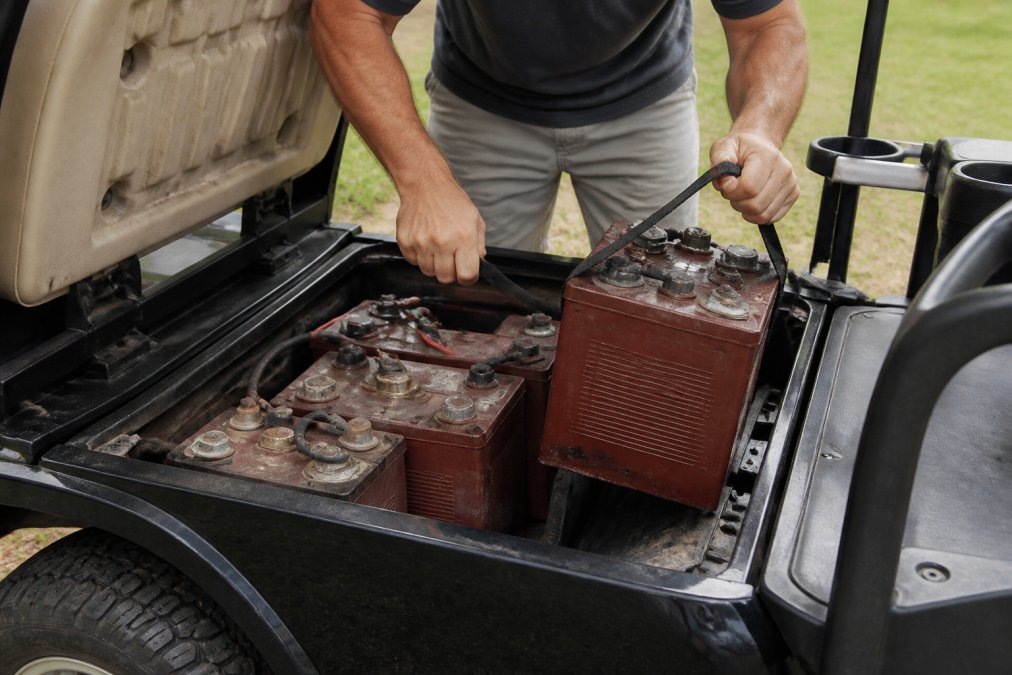
Clear your workspace and remove covers or seat cushions blocking battery access. A battery removal strap (included in most kits) makes lifting easier.
Removing Old Lead-Acid Batteries
Photograph your current battery configuration before disconnecting anything, this prevents confusion during reassembly.
Disconnect the negative terminal, then the positive. If corroded, spray penetrating oil and wait a few minutes.
Remove hold-down straps or brackets. Lift the first battery carefully, a standard 6V lead-acid battery weighs 60-70 pounds. Lift with your legs, not your back.
Remove each battery one at a time for safety and visibility.
Inspect the battery tray for corrosion, cracks, or debris and wipe clean. Check the charger port and wiring before reassembly.
Installing Your New Lithium Conversion Kit
Quality lithium conversion kits include the battery pack, charger, mounting brackets, wiring, and state-of-charge gauge.
Position the new battery in the tray and secure it firmly with mounting brackets. The battery should not move or rattle.
Connect the positive terminal first, then the negative.
Golf Cart Battery Maintenance Tips for Maximum Lifespan
Lithium batteries require virtually no maintenance compared to lead-acid, but a few habits will keep them performing at their peak.
Charging Profiles and Fast Charging Best Practices
Lithium batteries handle frequent charging without degradation. Plug in your cart after each use, partial charges don't harm lithium batteries like they do lead-acid.
Monitoring State of Charge and Thermal Management
Your cart's state-of-charge gauge is your primary tool for battery health monitoring. Check it regularly. A healthy battery at rest should show 100% when fully charged and drop gradually during use. If you notice the gauge dropping abnormally fast or staying stuck at one level, there may be a connection issue or a fault in the battery management system.
Real-World Range Testing: What to Expect
Range varies based on driving style, terrain, and cart configuration. A stock 48V cart on a quality 105Ah lithium battery typically delivers 30-40 miles per charge on flat terrain with moderate driving. Aggressive acceleration, frequent hill climbing, or rough terrain reduces this by 20-30%. Lighter drivers and smooth driving styles can exceed the rated range.
Warranty Coverage and Long-Term Cost Comparison
Most quality lithium batteries come with 5-8 year warranties. The 48V 105Ah CUBE Lithium Rhino Conversion Kit includes an 8-year warranty covering defects in materials and workmanship. This warranty typically covers battery failure, not degradation from normal use, so read the fine print.
Environmental Impact and Battery Recycling
Lead-acid batteries are recyclable, and most retailers accept old batteries as trade-ins when you buy new ones. The lead and plastic can be reclaimed and reused. However, the recycling process is energy-intensive and requires careful handling due to the sulfuric acid inside.
Frequently Asked Questions
Are Trojan batteries worth the money for golf carts?
Trojan batteries, particularly lithium options like those offered through conversion kits, deliver measurable value through extended range, reduced maintenance, and cycle life. A 48V 105Ah lithium conversion provides 30-40 miles of range. While the upfront cost is higher, the elimination of water fills, zero maintenance requirements, and 6,000+ charge cycles mean fewer replacements over time. For retirees and frequent users, the improved reliability is a significant benefit.
What is the average lifespan of a Trojan golf cart battery?
Traditional Trojan lead-acid batteries typically last 3-5 years with regular maintenance, including monthly water fills and proper charging. Lithium alternatives, such as the 48V 105Ah CUBE Lithium Rhino kit, extend lifespan to 6,000+ charge cycles, translating to 8-10 years of maintenance-free service under normal use. Cycle life depends on depth of discharge and charging habits; shallow discharges and consistent charging profiles maximize longevity across both battery types.
How do I know which Trojan battery voltage my golf cart needs?
Most golf carts use either 36V or 48V systems. Club Car, EZGO, and Yamaha models typically default to 48V, though older models may run 36V. Check your cart's charger output or battery tray to confirm voltage. A 48V system delivers higher peak power and faster acceleration, while 36V systems suit lighter-duty use. When upgrading, match your cart's existing voltage unless you're replacing the entire electrical system. The 48V 65Ah Lithium Rhino kit offers 27+ miles of range, while 36V options like the 105Ah Rhino deliver comparable performance for older carts.
What's the difference between lead-acid and lithium batteries for golf carts?
Lead-acid batteries require monthly water fills and cost less upfront ($400-800 for replacements). Lithium batteries are maintenance-free, charge faster, weigh 40-50% less, and deliver consistent power throughout the discharge cycle. Self-heated charging kits are available for cold weather use. The Epoch LiFePO4 48V 60Ah kit ($1,899) and 48V 105Ah CUBE Lithium Rhino ($2,299) both eliminate water maintenance and provide 8-year warranties, making them ideal for resort fleets and high-use environments.
Can I install a lithium battery conversion myself?
Yes, most conversion kits are designed for DIY installation. The 48V 50Ah Lithium Rhino ($1,299) is drop-in ready and weighs only 43 lbs, requiring basic tools and 1-2 hours. Kits include mounting brackets, heavy gauge wires, lead-acid removal straps, and safety gloves. However, if you're uncomfortable with electrical connections or your cart has a modified controller, professional installation is recommended. Golf Cart Geeks provides technical support at 1-888-409-5430 for installation questions.