

How to Extend Golf Cart Range: A Complete Guide
Table of Contents
- Understanding Golf Cart Range and Battery Capacity
- Lithium Battery Upgrade for Golf Cart Performance
- How to Maintain Golf Cart Batteries for Maximum Lifespan
- Golf Cart Battery Charging Tips for Optimal Range
- Golf Cart Range Per Charge: Performance and Upgrade Sequence
- Beyond Battery: Performance Upgrades That Extend Range
- Diagnostic Checklist Before Buying Upgrades
- Frequently Asked Questions
Last Updated: October 9, 2026
Understanding Golf Cart Range and Battery Capacity
To extend golf cart range, battery capacity is the most important factor: the bigger your battery's amp-hour (Ah) rating, the farther you'll travel on a single charge. Most stock carts deliver 20-25 miles per charge, and proper upgrades can realistically double that.
How Battery Amp-Hour Ratings Affect Distance Traveled
Amp-hour (Ah) rating measures how much energy a battery stores. A 105Ah battery holds twice the energy of a 52Ah battery, and range scales almost directly with capacity, like a bigger gas tank taking you farther:
- 48V 52Ah system: roughly 15-20 miles per charge
- 48V 105Ah system: roughly 25-35 miles per charge
- 48V 160Ah lithium system: roughly 40-50 miles per charge
Exact distance depends on terrain, weight, and driving style: flat pavement and light loads go farther than hills and heavy loads.

Real-World Range Estimation for Your Cart
Here's a practical method to estimate your actual range before and after upgrades.
Step 1: Note your current battery capacity. Find the Ah rating on your existing batteries. Most lead-acid golf cart batteries are either 52Ah or 105Ah.
Step 2: Calculate your baseline range. Multiply your battery's Ah rating by 0.25 to 0.35. This gives you a realistic miles-per-charge estimate:
- 52Ah × 0.3 = 15.6 miles
- 105Ah × 0.3 = 31.5 miles
- 160Ah × 0.3 = 48 miles
Step 4: Project upgrade impact. Going from 105Ah to 160Ah adds 55Ah, which at the 0.3 multiplier is roughly 16-17 additional miles per charge.
Lithium Battery Upgrade for Golf Cart Performance
Lithium batteries deliver more range per pound than lead-acid, plus they're lighter, charge faster, and last longer, making them the best way to extend golf cart range. The trade-off is upfront cost, but for serious range extension lithium is the only path that makes sense.
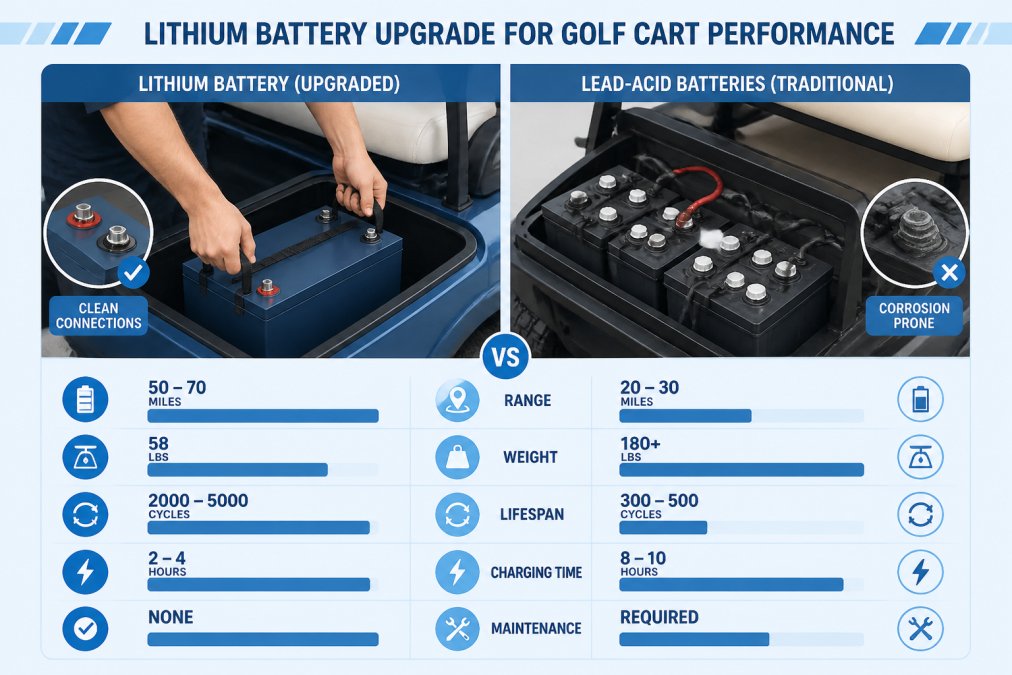
Lead-Acid vs. Lithium: Why the Chemistry Matters
Lead-acid batteries use lead plates and sulfuric acid: cheap and proven, but heavy, slow to discharge, and quick to degrade if run fully flat.
Lithium batteries (specifically LiFePO4 chemistry) use lithium iron phosphate cells.
The weight difference matters more than most people realize. A lighter cart accelerates faster, climbs hills better, and uses less energy to move the same distance.
Here's the practical difference:
- Lead-acid 105Ah system: roughly 400-500 pounds
- Lithium 160Ah system: roughly 150-200 pounds
That 250-pound savings means your motor works less hard, which equals longer range on the same charge.
Choosing the Right Amp-Hour Rating for Extended Range
Don't just pick the biggest battery available, match the upgrade to your needs and your cart's electrical system.
Most stock golf carts run a 48-volt system with a controller rated for 300-400 amps. A 160Ah lithium battery delivers sustained power much longer; the motor and controller can handle it, but weight distribution and handling change.

For most users, here's the right approach:
Stock carts (no other upgrades): A 90Ah lithium system (three 30Ah modules) gives you 30-40 miles per charge and fits in the stock battery bay without modifications.
Upgraded carts (larger tires, lift kit, modified controller): A 120-160Ah lithium system makes sense. Your upgraded motor and controller can use the extra power.
Fleet operations (resort golf carts): A 120-150Ah system balances range, weight, and reliability.
How to Maintain Golf Cart Batteries for Maximum Lifespan
Battery maintenance directly affects range: a neglected battery loses capacity faster than a well-maintained one. Lithium batteries need almost no maintenance; lead-acid demands regular attention.
Checking Battery Water Levels and Terminal Condition
Lead-acid batteries lose water over time, and the acid inside the cells must stay submerged, if levels drop, exposed lead plates corrode and fail.
Check water levels every 4-6 weeks if you use your cart regularly:
- Remove the battery caps (if your batteries have them)
- Look inside each cell
- The water should cover the plates by about half an inch
- If it's low, add distilled water only (never tap water)
While you're checking, inspect the battery terminals for corrosion:
- Clean white or blue crusty buildup with a wire brush
- Tighten any loose cable connections
- Replace any cracked battery posts
Preventing Battery Degradation and Early Failure
The biggest cause of battery failure is leaving your cart uncharged for weeks. A dead battery sulfates (develops crystals that reduce capacity). Once sulfation starts, it's nearly impossible to reverse.
Follow these rules:
- Charge your cart after every use, even if you only drove 5 miles
- Don't let the battery sit below 50% charge for more than a few days
- Avoid fully discharging the battery (running it completely flat)
- Store your cart in a garage or covered area, not in direct sun
- Keep terminals clean and connections tight
For lead-acid systems, use a smart charger that stops when the battery is full. Overcharging generates heat and accelerates degradation.
Lithium batteries are much more forgiving. They have built-in management systems that prevent overcharging and over-discharging. You can charge them partially or fully without damage.
Golf Cart Battery Charging Tips for Optimal Range
How you charge affects how far your battery takes you, and small routine changes add up to real range improvements.
Charging Frequency and Partial-Charge Benefits
Charge after every use to keep your battery in the 50-80% sweet spot, where it performs best and degrades slowest. You don't need to wait until it's dead, partial charging is actually better for lifespan:
- Charge after every 10-15 miles of driving
- Aim to keep the battery between 20% and 80% charged
- Avoid letting it drop below 10% or sit at 100% for days
This matters most for fleet operations: a cart charged multiple times daily outlasts one charged once daily at full discharge.
Lithium batteries have no "memory effect" and can be charged anytime without shortening lifespan. Lead-acid benefits from full cycles, but partial charging still works fine.
Cold Weather and Charger Compatibility
Cold weather reduces battery capacity by 20-30%: a battery delivering 40 miles in summer might only manage 28 in winter.
Eco Battery 48V 160Ah LifePo4 Golf Cart Battery - A-051160-06 →
Make sure your charger is compatible with your battery type. Lithium batteries need lithium-specific chargers. A lead-acid charger won't work properly with lithium and can damage the battery.
Golf Cart Geeks supplies chargers matched to each battery system. The RoyPow 48V 160Ah Lithium Battery includes a 48V charger with cart-specific connectors, eliminating guesswork.
Golf Cart Range Per Charge: Performance and Upgrade Sequence
You don't have to upgrade everything at once. A smart sequence maximizes range without wasting money on incompatible parts.
Baseline Range Expectations by Cart Model
Baseline ranges vary by motor size, controller rating, and weight:
- Club Car DS (stock): 20-25 miles per charge
- EZGO RXV (stock): 18-22 miles per charge
- Yamaha Drive (stock): 22-28 miles per charge
These assume flat terrain, moderate driving, and a well-maintained battery; hills, heavy loads, and aggressive acceleration cut range by 30-40%.
Step-by-Step Upgrade Path for Maximum Distance
Start with the battery. It's the foundation for everything else.
Phase 1: Upgrade the battery (biggest impact). Replace lead-acid with a 120-160Ah lithium system. This alone doubles your range.
Phase 2: Optimize tire pressure (free improvement). Underinflated tires create rolling resistance. Check pressure weekly and inflate to the manufacturer's spec (usually 18-20 PSI for golf cart tires).

Phase 3: Reduce unnecessary weight. Remove roof racks, extra seats, or cargo you don't need.
Phase 4: Upgrade the controller (if range is still limited). A higher-amp controller allows your motor to draw more power from your battery.
Phase 5: Upgrade the motor (advanced users only). A higher-performance motor uses energy more efficiently.
| Upgrade | Cost Impact | Range Improvement | Difficulty |
|---|---|---|---|
| Lithium battery (160Ah) | High | +50-100% | Moderate |
| Tire pressure optimization | None | +5-10% | Easy |
| Weight reduction | Low | +5-15% | Easy |
| Controller upgrade | Moderate | +10-20% | Hard |
| Motor upgrade | High | +15-25% | Hard |
Beyond Battery: Performance Upgrades That Extend Range
Range isn't just about battery size. Motor efficiency, gearing, and weight all play a role.
Motor, Controller, and Gear Ratio Optimization
Your motor's efficiency determines how much energy it wastes as heat; a well-tuned motor converts more battery energy into motion.
The controller manages power delivery.
Gear ratio affects torque and speed: a lower ratio (higher number) gives more climbing torque, a higher ratio (lower number) favors speed, and a moderate ratio best balances acceleration and efficiency for range.
Most stock carts use a 10:1 or 12:1 ratio, a good compromise. Changing gears means disassembling the final drive, a job for professionals.
Tire Pressure, Weight, and Terrain Impact
Tire pressure is the easiest lever: underinflated tires (below 18 PSI) create drag, while proper inflation (18-20 PSI) cuts rolling resistance by 10-15%.
Weight is second: every 100 pounds reduces range by 10-15%.
Terrain matters enormously: flat pavement delivers the advertised range, while sand, gravel, and hills cut it in half, steep hills by up to 70%. Plan your route accordingly.
Cold weather reduces range by 20-30%, and a 10-mph headwind can cost another 15-20%.
Diagnostic Checklist Before Buying Upgrades
Before spending money on upgrades, diagnose what's actually limiting your range, sometimes the problem is maintenance or settings, not battery capacity.
Identifying Battery-Related Range Loss
Start here:
- Check battery water levels (lead-acid only)
- Inspect battery terminals for corrosion
- Test actual range on flat terrain at moderate speed
- Compare to the baseline for your cart model
- Check tire pressure (should be 18-20 PSI)
- Weigh your cart (add up passengers and cargo)
- Note the weather (cold reduces range by 20-30%)
If your range is close to baseline, your battery is probably fine and the issue lies elsewhere. If it's 30-40% below baseline, the battery is degraded and replacement is the fix.
Compatibility and Installation Safety
Before ordering upgrades, verify compatibility:
- Confirm your cart's voltage (most are 48V, some are 36V or 72V)
- Check your current battery's Ah rating
- Verify your controller's amp rating
- Measure your battery bay to ensure new batteries fit
- Check for clearance around the battery area
Installation requires basic electrical knowledge. Lithium batteries have built-in safety systems, but they're still high-voltage equipment. Incorrect connections can damage the battery or start a fire.
If you're not comfortable working with electrical systems, hire a professional. The cost is worth the safety.
Golf Cart Geeks supplies complete kits with matching chargers, mounting brackets, and connectors.
Extending your golf cart's range starts with understanding what limits it today.
Frequently Asked Questions
How much can I realistically extend my golf cart range with a lithium battery upgrade?
Lithium batteries typically deliver 35% more range than comparable lead-acid systems. A cart averaging 25 miles per charge on lead-acid can reach 40-50 miles with a lithium upgrade like the Eco Battery 48V 160Ah or RoyPow 48V 160Ah, depending on terrain, driving habits, and cart weight. The Epoch 120Ah kit targets 40-50 miles for upgraded carts with modified controllers and larger tires.
What's the difference between amp-hour ratings and how do they affect golf cart range per charge?
Amp-hour (Ah) rating measures battery capacity. Higher Ah means more stored energy and longer range. A 90Ah lithium system typically delivers 30-40 miles, while 120Ah systems reach 40-50 miles. Your cart's controller, motor efficiency, and driving conditions also influence actual distance traveled per charge.
Should I upgrade to lithium now, or can I just replace my lead-acid batteries again?
Lithium batteries cost more upfront but last 10 times longer than lead-acid, require zero maintenance, and charge faster. Over 5-10 years, the total cost per mile is lower with lithium. If your current lead-acid batteries are failing and you drive regularly, lithium pays for itself through reduced replacement cycles and extended range capability.
What should I check before buying a battery upgrade to ensure it's actually a range problem?
Test your current range on a full charge over flat terrain. Check battery water levels (lead-acid only) and terminal corrosion. Inspect tire pressure and ensure it matches manufacturer specs, as low pressure reduces range. Verify your charger is working properly and not leaving batteries partially charged. If you're getting less than 50% of the rated range, battery degradation is likely the cause.