

5 Best Golf Cart Tires for Off-Road Use
Table of Contents
- How to Choose the Best Off-Road Golf Cart Tires
- Quick Comparison Table
- All-Terrain Golf Cart Tires: The Versatile Option
- Golf Cart Tire Sizes and Wheel Compatibility
- Golf Cart Lift Kit Requirements for Larger Tires
- Golf Cart Tire Pressure and Safe Operating Limits
- Durability, Tread Life, and Long-Term Ownership Costs
- Installation and Maintenance for Off-Road Tires
- Frequently Asked Questions
Last Updated: October 11, 2026
How to Choose the Best Off-Road Golf Cart Tires
Selecting the 5 best golf cart tires for off road use isn't just about picking the largest option available. The process comes down to understanding tread patterns, load capacity, tire pressure requirements, and whether your cart needs a lift kit to accommodate larger sizes.
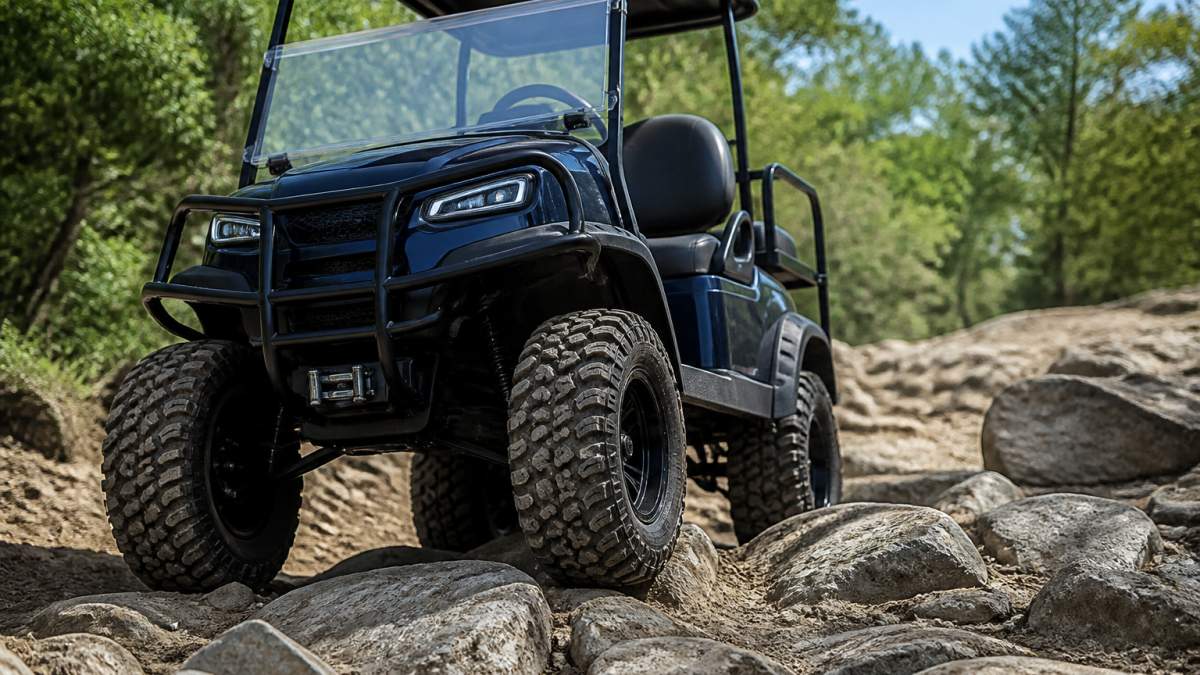
The foundation of your choice rests on three core decisions: terrain type, tire size compatibility, and performance priorities. Off-road golf cart tires fall into two main categories. All-terrain tires handle mixed surfaces with moderate tread patterns, balancing street performance and trail capability. Mud tires feature aggressive, widely-spaced tread blocks designed specifically for soft ground and deep mud, but they sacrifice pavement comfort and create road noise.
Traction and Tread Pattern Differences
Tread pattern is the primary factor determining how your golf cart performs across different surfaces. The tread design controls grip, water evacuation, and sidewall stability when turning on uneven ground. All-terrain tread patterns use moderate block spacing with interconnected grooves, providing reliable traction on grass, gravel, dirt, and pavement without excessive noise or vibration on paved surfaces.
The difference matters in real use. A cart equipped with all-terrain tires handles a quick trip to the golf course or community center with acceptable comfort, then performs adequately on dirt trails and rough terrain. A mud tire setup excels on challenging trails and wet conditions but creates a rough ride and excessive noise during street cruising. Most users benefit from the versatility of all-terrain designs unless your cart spends 80% of its time in genuinely muddy, soft-ground conditions.
Tire Performance Across Surfaces
Performance varies dramatically by surface type. On pavement, all-terrain tires with moderate tread deliver stable handling and reasonable tread life. Mud tires with aggressive patterns cause pulling, instability, and accelerated wear on asphalt. On grass and turf, both tire types perform well, though aggressive mud tires dig deeper and create more divots. On gravel and dirt roads, all-terrain tires provide adequate grip while maintaining control, whereas mud tires offer superior traction but may feel unstable due to their wide blocks.
Mixed-surface use, the most common scenario for golf cart owners, heavily favors all-terrain tires. You get acceptable performance everywhere rather than excellent performance in one condition and poor performance in others.
Quick Comparison Table
| Tire Option | Tread Type | Best Surfaces | Ride Quality | Road Noise | Load Capacity | Price Range |
|---|---|---|---|---|---|---|
| All-Terrain (Standard) | Moderate block spacing | Mixed surfaces, pavement, grass | Smooth | Low | 800-1025 lbs | $149-$300 |
| Aggressive Mud Tires | Large, spaced blocks | Mud, soft ground, trails | Rough | High | 800-1025 lbs | $200-$400 |
| Low-Profile All-Terrain | Moderate tread | Pavement-focused use | Very smooth | Very low | 700-900 lbs | $120-$250 |
All-Terrain Golf Cart Tires: The Versatile Option
All-terrain golf cart tires represent the practical choice for most owners. These tires balance off-road capability with street usability, making them ideal for carts that leave the community, navigate unpaved resort roads, or handle mixed terrain without requiring a specialized mud setup.
Golf Cart Geeks carries several all-terrain options that exemplify this versatility. The 22x10-14 GTW Timberwolf A/T Tire is purpose-built for lifted golf carts with 14-inch wheels. Its 4-ply nylon tubeless construction withstands rough terrain while the moderate all-terrain tread pattern ensures excellent grip and stability on any trail. The tire carries an 815-pound load capacity and operates safely at up to 36 PSI.

The STEELENG all-terrain options offer a bundled approach. The SGC 12" Fang wheel paired with STEELENG 22"x10.5"-12" STINGER All-Terrain Tire combines DOT-rated hybrid all-terrain tires with machined aluminum wheels and center caps in one package at $712.49.

Golf Cart Tire Sizes and Wheel Compatibility
Tire size directly determines what wheels fit your cart and whether a lift kit becomes necessary. Golf cart tires range from 18 inches to 23 inches in diameter, with width varying from 8 to 11 inches. Your current wheel size, typically 10, 12, or 14 inches, constrains which tires mount properly. A 14-inch wheel accepts tires in the 22-inch range. A 12-inch wheel works with 20-22 inch tires. An 10-inch wheel limits you to 18-20 inch options.
Larger tires improve ground clearance and provide more cushioning over rough terrain, but they also increase rolling resistance and place greater demand on your cart's motor. Electric carts experience reduced range with larger tires. Gas carts see slightly reduced fuel efficiency. The practical sweet spot for most users is a 20-22 inch tire, which balances ground clearance improvement, terrain capability, and performance impact.
Understanding Load Capacity and Fitment
Load capacity indicates the maximum weight each tire can safely support at its rated pressure. Most golf cart all-terrain tires carry capacities between 800 and 1025 pounds per tire.
To determine your cart's actual load requirement, add the cart's dry weight, the weight of four passengers (assume 200 pounds each), and any cargo or equipment. Divide this total by four to find the required load capacity per tire. The STEELENG STINGER tires at 800-1025 pounds per tire handle most standard and moderately loaded carts.
Fitment compatibility extends beyond tire size to bolt pattern and offset. All modern golf carts use a 4x4 bolt pattern, and most aftermarket wheels maintain a 3+4 offset (-12mm) to prevent rubbing. The STEELENG wheel options from Golf Cart Geeks are engineered specifically for EZGO, Club Car, and Yamaha models, ensuring proper fitment without modification.
Golf Cart Lift Kit Requirements for Larger Tires
A lift kit becomes necessary when upgrading to tires larger than your cart's original size by more than one inch. Stock golf carts typically come with 18-inch tires.
Lift kits raise the cart's frame 2-4 inches, creating clearance for larger tires and improving ground clearance for off-road obstacles. They also improve approach and departure angles, helping your cart navigate steep terrain without the chassis catching on rocks or roots.
The GTW Timberwolf A/T Tire explicitly requires a lift kit due to its 22x10-14 size. Without lift kit installation, this tire will contact the wheel well during normal operation. If your cart doesn't yet have a lift kit and you're planning to upgrade to larger tires, budget for both components as a complete system.
22x10-14 GTW Timberwolf A/T Tire →
Golf Cart Tire Pressure and Safe Operating Limits
Tire pressure directly affects traction, ride quality, and tire lifespan. Under-inflated tires generate excessive heat, wear quickly, and provide poor handling. Over-inflated tires reduce grip, create a harsh ride, and concentrate wear in the center of the tread. The correct pressure depends on your specific tire and load.
Most all-terrain golf cart tires operate safely between 18 and 36 PSI. The GTW Timberwolf carries a maximum pressure of 36 PSI. The STEELENG STINGER tires operate at 22 PSI for rated load capacity. These pressures are significantly lower than automobile tires because golf carts are lighter and operate at lower speeds.
Start at the tire manufacturer's recommended pressure and adjust based on conditions. Softer pressure (lower PSI) improves traction on soft ground and reduces vibration on rough terrain. Firmer pressure (higher PSI) extends tread life and improves handling on pavement. For mixed-use carts, aim for the middle of the recommended range.
Durability, Tread Life, and Long-Term Ownership Costs
All-terrain golf cart tires typically last 3-5 years or 5,000-8,000 miles, depending on usage intensity and maintenance. Mud tires, with their aggressive tread, wear faster on pavement and may require replacement after 2-3 years of mixed use. This means all-terrain tires provide better long-term value for most owners.
Tread depth determines when replacement becomes necessary. New tires typically have 10-12 mm of tread. Most manufacturers recommend replacement when tread depth falls below 4 mm. You can check tread depth using the penny test: insert a penny into the tread groove. If you see the top of Lincoln's head, tread is below 4 mm and replacement is due.
Durability depends heavily on maintenance. Proper tire pressure, regular rotation, and avoiding extreme off-road abuse extend tire life significantly. Carts used primarily on pavement see tires last toward the upper end of the range. Carts used aggressively on rocks, roots, and mud see faster wear.
Installation and Maintenance for Off-Road Tires
Installing new tires and wheels on your golf cart requires basic tools: a tire iron, jack, and lug wrench.
The process is straightforward: lift the cart safely, remove the lug nuts, slide off the old wheel and tire assembly, mount the new wheel, hand-tighten lug nuts, lower the cart, and torque the lug nuts to specification (typically 80-100 foot-pounds for golf carts).
Maintenance after installation is minimal. Rotate tires every 1,000-1,500 miles to promote even wear. Check pressure monthly and before off-road trips. Inspect tires visually for cracks, punctures, or uneven wear patterns.
Seasonal storage requires attention. If your cart sits unused for winter months, inflate tires to the upper end of the recommended range to prevent flat-spotting. Cover the cart to protect tires from UV damage and ozone degradation.
Upgrading your golf cart's tires is one of the highest-impact improvements you can make. Golf Cart Geeks offers purpose-built all-terrain tire and wheel combinations like the STEELENG STINGER bundles and GTW Timberwolf options, each engineered for compatibility with Club Car, EZGO, and Yamaha models.
Frequently Asked Questions
What are the best golf cart tires for off-road use?
The best golf cart tires for off-road use depend on your terrain and cart setup. All-terrain tires like the GTW Timberwolf A/T (22x10-14 size, $149.99 per tire) and STEELENG STINGER options offer aggressive tread patterns that grip mud, dirt, gravel, and mixed surfaces. Choose based on whether you need a hybrid tire for street-and-trail versatility or pure off-road performance. Ensure your cart has a lift kit if you're upgrading to larger sizes.
Do I need a lift kit for larger golf cart tires?
Yes, a lift kit is required for larger golf cart tires. The GTW Timberwolf A/T (22x10-14) explicitly requires a lift kit to fit properly and maintain ground clearance. A lift kit raises your cart's suspension, preventing tire rub against the frame during turns and off-road movement. Without one, larger tires can damage your cart's body and suspension. Check your cart's current wheel size before purchasing, if you're moving from stock 10-inch wheels to 14-inch or larger, budget for a lift kit upgrade.
What golf cart tire pressure should I use?
Golf cart tire pressure varies by tire model and load. The GTW Timberwolf A/T has a maximum pressure of 36 PSI, while STEELENG STINGER tires operate at 22 PSI for their rated load capacity (1025 lbs for the 22-inch model, 800 lbs for the 20-inch model). Always check your specific tire's sidewall or product specifications for correct pressure. Proper pressure ensures traction, ride comfort, and tire durability. Under-inflation reduces grip and increases wear; over-inflation can cause a rough ride and uneven tread wear.
What tire size should I choose for my golf cart?
Golf cart tire sizes range from 18 inches to 22+ inches in diameter. Common sizes include 20x10-12 and 22x10-14. Larger tires (22-inch) offer more ground clearance and aggressive tread for serious off-road use but require a lift kit. Smaller sizes (20-inch) fit stock or lightly lifted carts. Check your cart's bolt pattern (typically 4x4) and current wheel size before ordering. The STEELENG 20-inch and 22-inch options fit EZGO, Club Car, and Yamaha models with standard 4x4 bolt patterns.
Are all-terrain golf cart tires street legal?
Most quality all-terrain golf cart tires are street legal if they carry DOT (Department of Transportation) certification. The STEELENG STINGER tires in our lineup are DOT-rated, meaning they meet safety standards for street use. However, local regulations vary, some communities restrict golf cart use on public roads regardless of tire type. Check your local ordinances before taking your cart onto streets. Even DOT-rated tires should be used primarily for their intended surface; aggressive mud tires may perform poorly on pavement.